How many writers wish they could write a character like Sherlock Holmes? My guess is most of them. Sherlock Holmes is the best-known fictional character still, although that whippersnapper Harry Potter has quickly risen to number two in recent decades. Put together a deerstalker, a magnifying glass and a pipe, and readers all over the world know what to expect—a mystery. They quote lines like “Elementary, my dear Watson”, although he never actually said that, at least not in Sir Arthur Conan Doyle’s original stories, or what Sherlockians like me call “The Canon”.
To Conan Doyle, the success was a mixed blessing. The public craved more Sherlock, while Doyle wanted to distance himself from his monster creation to focus on more literary historical works. It was a strange battle, during which Doyle killed off the detective in 1893. In response to public outcry, he wrote The Hound of the Baskervilles as a memoir of the late Holmes.
However, the Hound only whetted the appetite of the voracious readership, and the author gave in, cunningly bringing Holmes back to life in “The Adventure of the Empty House” in 1903. From then until just three years before his death in 1930, Doyle penned thirty-two more short stories and one novel about the immortal Sherlock Holmes.
Sherlock Holmes, Vincent Starrett wrote in 1940, “… never lived and so can never die”. He was a member of the Baker Street Irregulars, the first officially acknowledged Sherlockian Society formed in New York City in 1934. The BSI is still by invitation only, but you can join one of hundreds of scion societies throughout the world.
I have just received a wire instructing me to remind my readers that the Sherlock Holmes Society of London is not a scion of the Baker Street Irregulars and is the preeminent Holmesian society in the United Kingdom. Let’s not start a diplomatic incident. Someone might be killed, and the Great Detective would not want to take sides.
Regardless, the generally accepted adoring principles are that Holmes and Watson were (are) real people, and all conflicting details in The Canon (are you keeping up with the terminology?) must and can be explained. This is the basis for the meetings, the debates, the papers, the dinners, and especially, the drinking. Yes, there are tests. Prancing through Times Square in Victorian gear is also sometimes required, but that’s a whole other blog post.
The first story that I remember reading was “The Dying Detective”—a very odd introduction, but I was hooked. I joined the Bootmakers of Toronto at the tender age of seventeen. My parents drove me in from the suburbs and waited to take me home.
Why Bootmakers? Look it up. I’ll give you a hint: it’s in the aforementioned Hound. Anyhoo … my contribution to Sherlockian studies was a paper proving that Bernard Shaw’s friendship with Holmes and Watson, and his visits to the Baker Street household, influenced his Pygmalion. I also wrote canonical song parodies, such as “On the Street Where He Lives”. Only a Sherlockian knows why that’s relevant. If you wish to share with the class by posting the explanation in the comments section below, please do.
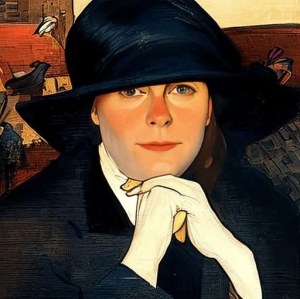
The Photo: An Ai-enhanced photo of me enjoying Sherlockian heaven in NYC in the 1990s as a Master Bootmaker of Toronto (MBt), an Adventuress of Sherlock Holmes (ASH) and a guest of the Algonquin Hotel. I really miss that hat!
Carole

One response to “Doyle vs. Holmes”
-
Carol: The phrase “Elementary, my dear Logan” also sounds appealing. What do you think? I am always learning something new, every day. Consider that I have heard the name Sherlock Holmes (and Watson) many, many times in my life. But Sir Doyle’s name did not ring a bell today. Gordon
LikeLike


 C.A. Logan Author
Leave a reply to clearlyb76809f9f7 Cancel reply