
PART TWO: Western Australia, circa 1873 – Archie Sloss, the escaped convict and robber, was in hiding from the police with a price of two hundred pounds on his head. How would he get away?
Archie tells us that nine days after the police raided the hideout, Donald Macvittie, a respectable Scottish shepherd, bought passage on a ship to England. The police came searching for the escaped Archie Sloss and handed “Donald” a copy of the arrest notice. He slipped it into his pocket. Once at sea, “Donald” charmed the crew, sitting with the night watch, “telling yarns of wild bush life, of wicked convicts, shootings, stabbings, murder, and sudden death, and of the desperado Archie Sloss, who cared for nowt nor nobody.” In the meantime, he did a good deed for the man dying in the berths below deck.
In that excerpt from ‘Dead and Buried’, we see Archie promoting his own myth within the story. It merges truth, embellished truth, and fable. At the risk of bursting bubbles, the historical records say that Archibald Sloss served 12 years in jail and left Australia peacefully on a ship to Maine. But did he really escape from Sing Sing? I can’t find it. I’m not saying that Archie is lying, just that I am a bad genealogist. And hey, Archie’s story is better. At this point, I, the fiction writer, push the genealogist out of the way.
Archie dwelt little on the historical context of public events or personal relationships. His task was to focus on his crimes, his mistakes, his good deeds, and the consequences. His narratives were thematic, not sequential. Whatever worked. Wherever the story led.
We could engage in an academic discussion of the socio-economic conditions for workers relocated from rural communities to nineteenth century Glasgow. But let Archie do it. His stories reveal how the lower classes suffered from a puritanical, selfish, self-aggrandizing hierarchy. Ipso facto, to steal from such people was not a sin, but a necessity. Archie’s moral code was to be fair to those who were fair to him and to the weak, and this led to his occasional acts of generosity. The good deeds always backfired on him, and when he fell, he fell hard onto the bottom rung of the ladder.
Judges, remarking on his sanguine demeanour, sentenced Archie to Portland Prison so frequently that they called him “The Duke of Portland.” His sardonic, resilient temperament kept him going. With glee, he recounted drinking too much before a break-in and falling asleep with the swag in his arms until the “Peelers” awakened him. Archie didn’t just tell stories, he performed and embellished them for his audience, whether fellow criminals, easy marks, or compassionate do-gooders. His life rotated between luxury, prison, brilliant schemes, and destitution. He travelled the world of the nineteenth century as a convict labourer. He loved a good costume, and his favourite disguises were priests or ministers. I call this foreshadowing.
By 1889, Archie, past 60, had three options for a night’s rest – a park bench, the workhouse or getting arrested. The good old days were clearly over. At the back of the Horse Shoe Brewery, a stranger directed him to the Salvation Army. Was this a ruse — some sort of fit-up? He received food and a warm bed. They invited him to stay indefinitely. But what did they want in return? The answer surprised him. Devotion to Jesus and an honest life? After everything he had suffered … Archie accepted the challenge, and the last phase of his life began.
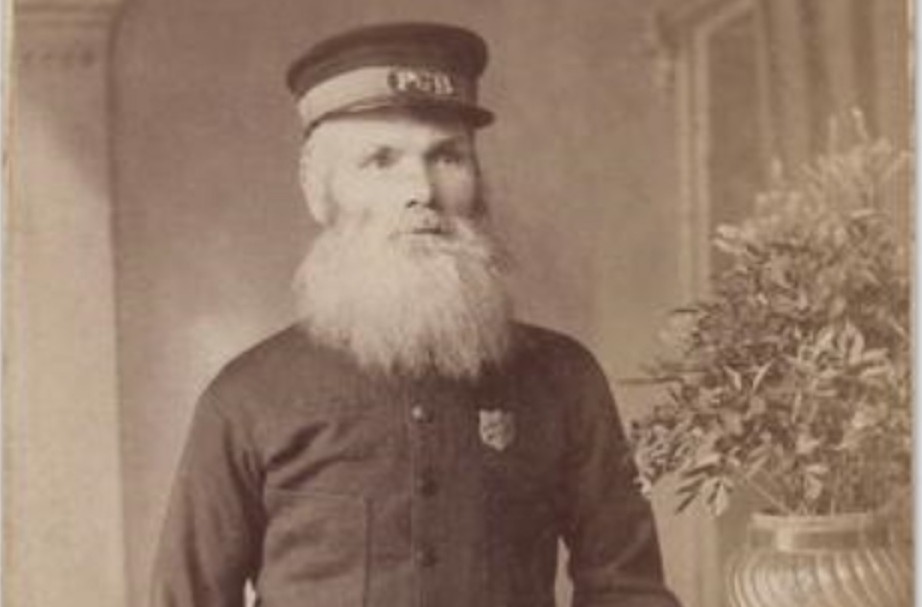
Archibald Sloss was reborn as the Salvation Army’s Messenger and Porter at the Prison Gate Home, King’s Cross. His morning post was at the Pentonville Prison gates. He engaged the released prisoners with a bit of chatter and a story that reminded them of his criminal credentials. Then he brought them down the Caledonian Road for warm cocoa and bread.
The Salvation Army celebrated their trophy. Archie testified at events throughout Britain. The crowd trembled at the sins of the “Burglar with the Blue Scar”. Then “Old Dad Sloss” appeared and spoke of Redemption. Postcards of Archie were available in the lobby for a shilling.
God’s Army may have harnessed the brilliance of the reformed criminal, but London’s Westminster Gazette made him a Victorian media sensation. The Gazette was a liberal publication that advocated social reforms with stories that humanized the underclasses for their bourgeois readers. The journalist Charles Morley ventured into Archie’s humble garret in Argyle Street, where the ex-convict’s storytelling enchanted him.
The Gazette syndicated their articles internationally and later compiled them into the 1897 book “Archie, or the Confessions of an Old Burglar”. As a writer myself, I am compelled to include the South London Press’ review: “apart from their interest as contributions to the literature of criminology, (the stories) are penned with a brightness and sparkle that really make them quite fascinating.”
A few years ago, I stood outside Pentonville Prison and walked back to the location of the Prison Gate Home, feeling Archie beside me. I still wonder if it was faith that reformed Archie, or finally receiving some respect? I’ve asked, but he won’t tell me. Apparently, Archie doesn’t want to ruin the story. Morley had often found Archie staring out at the world from his garret, his demeanour gloomy or thoughtful, but alert as a cat to the squeak of the stair tread. His private hours seem a stark contrast to his spirited performances. I would give more than a penny for those thoughts.
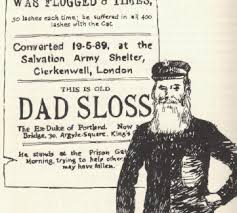
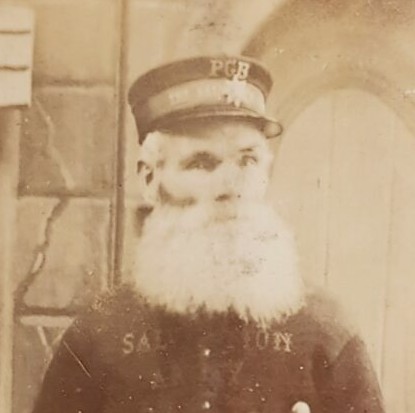
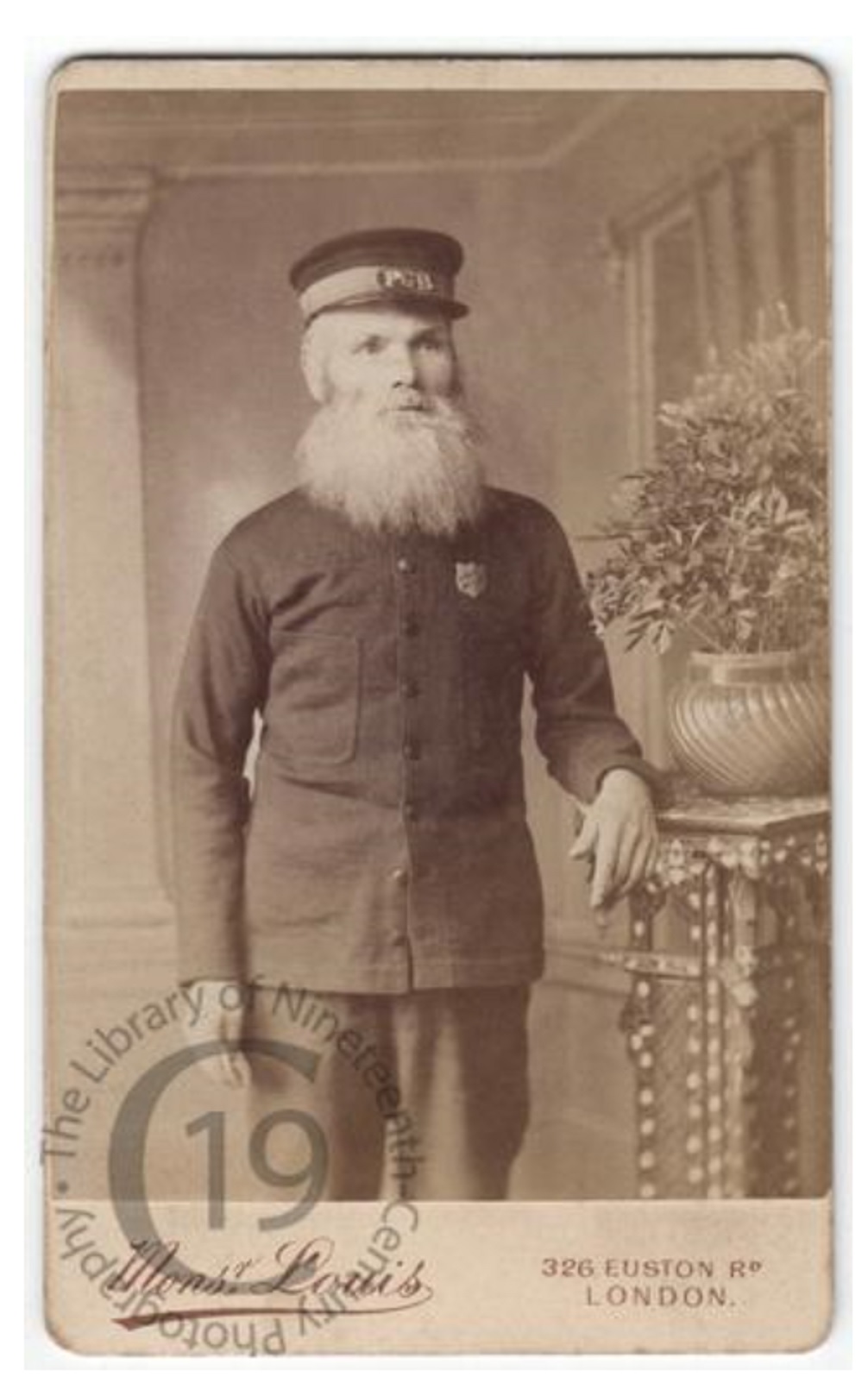
Three real images of Archie Sloss of the Salvation Army
Could Archie have imagined the London crowds that followed his funeral procession in January 1900? It was a grand ceremony that carried the burglar, who “died triumphant,” to his rest in Abney Park Cemetery. You can visit at plot number 97138, section F04. William Booth, the founder and first General of the Salvation Army, lies a few metres away. They’ve tidied up Archie’s grave a bit.
Tell him I was asking after him. Tell him I am working on a retelling of his life. It won’t be strictly historical — some sections need a little patching and cobbling — but a joint venture between me, Archie, Charles Morley, and history. I’ll try to do Archie proud, from one Sloss to another. He deserves it.
Carole

5 responses to “Archie Sloss: The Burglar Who Stole the Heart of Victorian Society”
-
Wow! Great writing! What an interesting scoundrel. Love it!
LikeLike
-
brilliant….I can’t wait
LikeLike
-
Hi Carole,
I loved your retelling of the Archie Sloss story and have been looking out for information on him over recent years.
I still have not found a copy of Charles Morley’s book (an interesting character in his own right). Were you aware that The Salvation Army serialised his story in the the War Cry during his life time (quite separate from ‘The Burglar with the Blue Scar’)? I have always wondered whether the War Cry version simply rehashes Morley’s book or is different.
I am so pleased to hesr you are working on a book and would live to have a copy when you get that far.
Regards
Martin
LikeLike
-
Thanks for your kind comments! I’ve had Morley’s book so long, I can’t remember exactly where I bought it – it’s a pdf version. I recently acquired Morley’s ‘Travels in London’ to get a wider view of him.
I am aware of the War Cry stories. I’ve read excerpts online and the writing style is distinct from Morley. I tried to get copies, even called the Salvation Army once (that didn’t go well).
I’ve also seen some “copycat” stories in magazines at least into the 1920s. So there’s a lot of versions to sort through, along with my own historical research.
I am writing an Archie novel but not sure yet on the schedule. However, please stay tuned!
LikeLike
-
Hi, I should be able to give a pointer to some accessible War Cry narratives. At the moment I am visiting family overseas but when I return home I can easily look up the resources. Regards. Martin
LikeLike
-
-


 C.A. Logan Author
Leave a reply to c.a.logan Cancel reply